Impacted Wisdom Teeth Extraction in Adults NJ: A Specialized Approach
If you are reading this, likely you or a loved one has been told that impacted wisdom teeth extraction in adults NJ is necessary—decades after the typical teenage timeframe. I understand the hesitation. We are often told that if wisdom teeth do not bother us in our youth, they should be left alone. However, the biological reality changes as we age.
Performing this procedure requires a level of surgical precision and expertise distinct from routine adolescent dentistry. At my practice in Westfield, we specialize in navigating these complexities. We move beyond the simple “pulling of teeth” to a sophisticated, medically precise surgical intervention designed to protect your long-term oral health while ensuring your absolute comfort.
For the discerning adult patient over 30, understanding why this procedure is more complex—and how we mitigate those risks through technology and sedation—is the first step toward a healthier smile.
The Biological Reality: Why Extracting Wisdom Teeth in Adults Differs from Teenagers
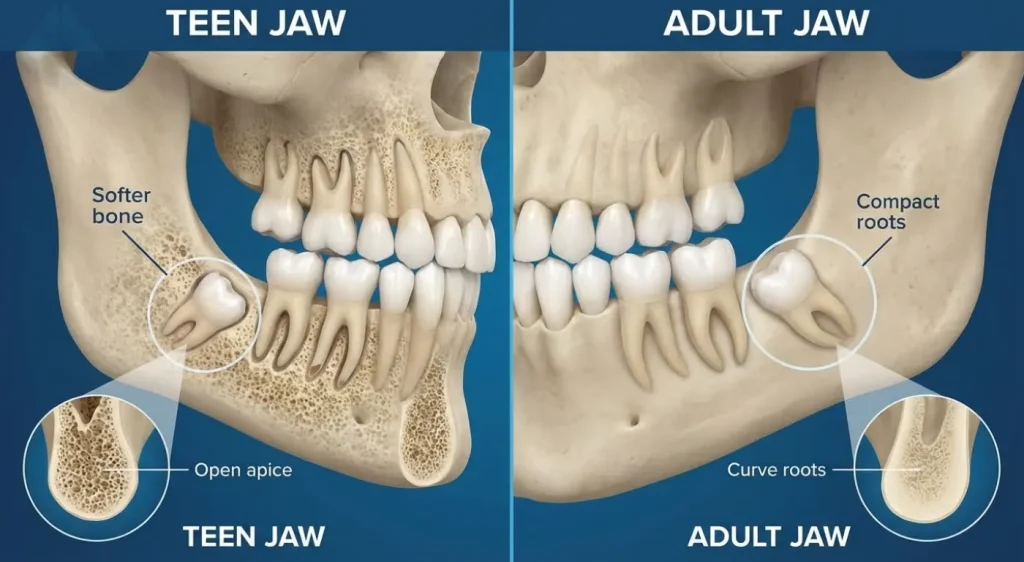
The human jaw undergoes significant changes between the ages of 18 and 35. When we treat teenagers, the bone surrounding the third molars is relatively soft and pliable, and the roots of the teeth are often not fully formed. This makes extraction straightforward and recovery rapid.
However, in adult patients, the physiology shifts. The jawbone becomes denser and more calcified. Simultaneously, the roots of the wisdom teeth fully develop, often curving or hooking deep into the mandible. According to the American Association of Oral and Maxillofacial Surgeons (AAOMS), as wisdom teeth develop, the roots become longer and the jawbone denser, making extraction more complicated as you age. In some cases, a condition known as ankylosis occurs, where the tooth root fuses directly to the surrounding bone.
Ignoring these teeth because of age is rarely the solution. As the bone hardens, the space for these teeth remains restricted, leading to chronic low-grade inflammation that can affect systemic health. Recognizing these differences is why we approach adult cases with a unique protocol.
The Hidden Dangers: Understanding Impacted Molars and Nerve Proximity
Not all wisdom teeth are created equal. An “impacted” tooth is one that is blocked from entering the mouth normally. In adults, these impactions often present in complex angles—horizontal, mesial (tilted forward), or distal (tilted backward).
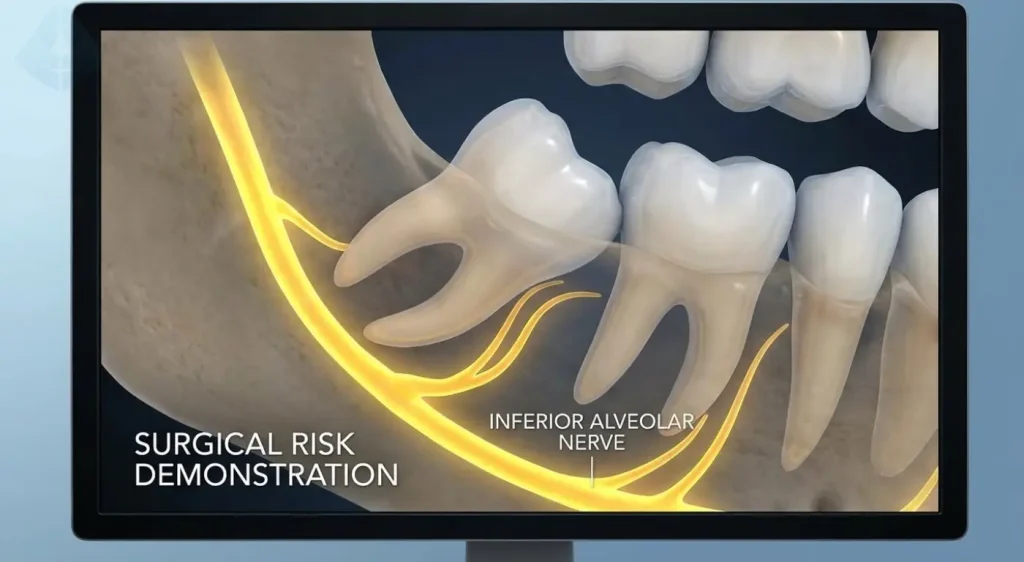
The primary concern with impacted wisdom teeth extraction in adults NJ residents often face is the proximity to the inferior alveolar nerve. This major nerve runs through the lower jaw and supplies sensation to the lip and chin. In fully developed adult roots, the nerve canal can be intimately close to, or even wrapped around, the roots of the wisdom tooth.
Furthermore, retained impacted teeth in adults are susceptible to pathology. Cyst formation and pericoronitis (infection of the gum tissue) become more prevalent risks after age 30. A cyst can silently expand, eroding the jawbone and damaging adjacent healthy molars before pain is ever felt. This is why proactive evaluation is critical, even in the absence of acute pain.
The Complexity of Impacted Wisdom Teeth Extraction in Adults NJ
To ensure safety when performing impacted wisdom teeth extraction in adults NJ, we must move past standard 2D X-rays. Standard radiographs often flatten the image, making it difficult to determine exactly where the nerve lies in relation to the tooth root.
The Carranza Protocol Part 1: Utilizing 3D CBCT Scanners
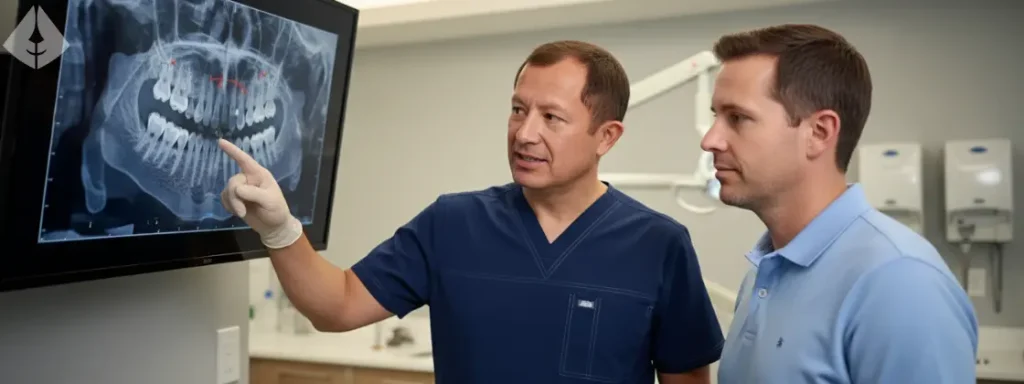
In my Westfield practice, I utilize advanced Cone Beam Computed Tomography (CBCT). This 3D imaging technology allows me to visualize your anatomy in three dimensions. I can rotate the image of your jaw on the screen, slicing through layers to see the exact path of the nerve and the precise curvature of the roots.
This “surgical mapping” eliminates guesswork. Before I ever begin the procedure, I have planned the angle of approach that avoids critical structures. For the adult patient, this technology is not a luxury; it is a necessity for preventing paresthesia (temporary or permanent numbness) and ensuring a minimally invasive surgery.
The Carranza Protocol Part 2: IV Sedation and ‘High-End Dentistry Without Anxiety’
Perhaps the greatest barrier to treatment for adults is anxiety. The memory of dental trauma or the fear of “being awake” during a complex procedure is valid. My philosophy is “High-End Dentistry Without Anxiety,” and this is achieved through Intravenous (IV) Sedation.
I am one of the select dentists in New Jersey certified to administer IV sedation. Unlike oral sedatives which can be unpredictable, IV sedation allows me to control your level of consciousness precisely. You are not merely “relaxed”; you are in a twilight sleep state. You will not remember the sounds, the pressure, or the passage of time. For phobic patients, this transforms a dreaded surgery into a peaceful nap. You wake up with the procedure finished, avoiding the psychological stress that often accompanies dental surgery.
Surgical Finesse: Minimally Invasive Sectioning vs. Traumatic Force
In the era of old-school dentistry, removing a stubborn tooth often involved significant force. This is exactly what we avoid, especially with the denser bone of an adult patient. Force equals trauma, and trauma equals swelling and prolonged recovery.
My approach relies on surgical finesse. Using high-precision handpieces and sometimes dental lasers, I employ a technique called “sectioning.” Instead of trying to remove a large, multi-rooted tooth in one piece, I carefully divide the tooth into smaller segments. These segments are then gently removed through a small opening.
This technique preserves the surrounding bone and minimizes trauma to the soft tissue. It is significantly gentler on the jaw joint (TMJ) and results in far less post-operative swelling than traditional extraction methods.
Accelerated Recovery: Specialized Post-Op Care for the Adult Physiology
We must be honest: recovering from wisdom teeth removal at 45 takes longer than at 16. However, with the right protocol, it is manageable and predictable.
Because adult bodies have a slower inflammatory response, we utilize advanced post-operative strategies. This includes specific pharmacological protocols to manage inflammation before it begins (pre-emptive analgesia). We also provide detailed guidance on nutrition and hygiene to prevent dry socket—a condition more common in older patients due to reduced blood supply in the dense bone.
Our team monitors your recovery closely. We don’t just send you home with a gauze pack; we partner with you through the healing process to ensure your return to normal life is as swift as possible.

Why Westfield Chooses Dr. Carranza: Expertise Meets Empathy
Choosing a provider for impacted wisdom teeth extraction in adults NJ is a decision that affects your health and peace of mind. It requires a provider who bridges the gap between a general dentist and a hospital surgeon.
As an Associate Fellow of the AAID and a Rutgers graduate, I have dedicated my career to mastering the complexities of the oral maxillofacial structure. But beyond the credentials and the 3D scanners, my practice is built on empathy. I treat the person, not just the X-ray. I understand that sitting in the dental chair requires trust, and I honor that trust by delivering perfectionist results with a gentle touch.
If you have been postponing addressing your wisdom teeth due to fear or uncertainty, I invite you to schedule a consultation at our Westfield office. Let us use our technology and expertise to turn a complex procedure into a comfortable, health-affirming experience.